
The 6 Best Apps for Trading on Hyperliquid in 2026
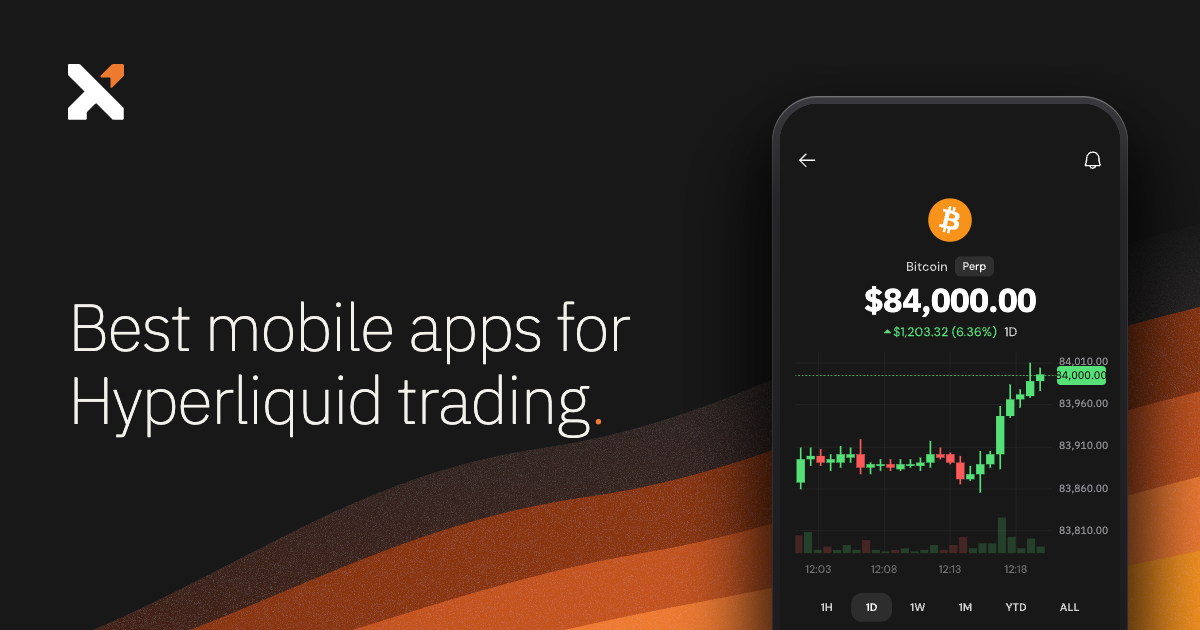
Compare the best mobile apps for trading on Hyperliquid in 2026. Trade crypto perps, tokenized stocks, gold, and oil using Xverse, Phantom, MetaMask, Rabby, and Stack.
Story details
Topics
Author(s)
Janlo van den HeeverPublished
October 8, 2026
Sign up for updates!
Stay tuned to our latest news and updates
.svg)
Hyperliquid is no longer just a crypto exchange. With over 365 trading pairs, $6B in daily volume, and tokenized markets covering SpaceX, gold, oil, and the S&P 500, it has quietly become one of the most liquid trading venues on the planet. Crypto still dominates the order book. BTC, ETH, and HYPE hold over $5B in open interest between them. But the signal is what else showed up: SK Hynix, a Korean semiconductor stock, now carries more open interest than SOL. Four of the top twelve markets are not crypto. Traditional and digital markets are colliding on one protocol.
The catch: Hyperliquid does not have its own mobile app. To trade from your phone, you need a third-party app that connects to the Hyperliquid DEX. Several have launched integrations over the past year, each with a different approach to funding, chains, and user experience.
This guide breaks down the six best mobile apps for trading on Hyperliquid in 2026, ranked by how much they actually let you do from your phone.
Availability: Hyperliquid perps are not available in the US and some other regions. This restriction is enforced by Hyperliquid directly and applies to every app on this list.
What Makes a Good Hyperliquid Trading App?
Before comparing options, here is what matters when choosing an app to trade Hyperliquid perps:
Capital efficiency. Can you fund trades without selling your existing positions? The best apps let you deploy capital from yield and borrowing rather than liquidating your holdings.
Mobile-native experience. A desktop extension crammed into a phone screen does not count. The app should be purpose-built for mobile trading with proper order management, position tracking, and one-tap execution.
Funding flexibility. How do you get capital into your Hyperliquid account? Some apps require specific chains or tokens. The best ones let you fund from whatever you already hold.
Market coverage. Hyperliquid offers 100+ perp markets spanning crypto, tokenized stocks, and commodities. Not every integration gives you access to all of them.
What else can you do? Trading is one financial action. The strongest apps let you do more with your capital: earn yield, borrow, spend, manage a portfolio. Trading in isolation is useful. Trading as part of a full financial stack is powerful.
The 6 Best Apps for Trading on Hyperliquid in 2026
1. Xverse
Best for: Bitcoin holders who want to trade every market without selling their BTC.
Xverse is the first Bitcoin-native platform to integrate Hyperliquid perps. That matters because no other Hyperliquid integration starts from Bitcoin. Every other app on this list assumes you are coming from Ethereum, Solana, or Arbitrum. Xverse lets you fund trades directly from your vault using BTC or USDC on Starknet. No CEX account required. No broker. No selling your Bitcoin to get into position.
The market access is full: 100+ perp markets across crypto (BTC at 40x, ETH, HYPE), tokenized stocks (SPX500, SPACEX, AMD, SAMSUNG), and commodities (GOLD, SILVER, WTIOIL). This is where the real angle sits. You can go long gold and short oil from the same vault that earns yield on your Bitcoin. That combination does not exist anywhere else.
What makes Xverse different from every other option on this list is what happens before and after the trade. This is not a standalone trading app. It is a financial operating system for Bitcoin holders. The real power is the flywheel: earn native yield on BTC through hBTC, borrow stablecoins against your position, and deploy that capital to Hyperliquid when the setup appears. You never sell your Bitcoin to fund a trade. You never miss a generational entry because your capital was locked or illiquid. Add spending via the Xverse Card and instant payments through Flashnet, and every financial verb runs from one vault.
The integration is also the newest and freshest of any platform listed here. While Phantom launched in mid-2025 and MetaMask followed later that year, from v2.11 Xverse ships Hyperliquid perps on mobile alongside the full neobank stack: Earn, Borrow, Spend, and Pay Anyone. The entire product is designed around the neobank thesis: if you hold Bitcoin, you should be able to do everything with it.
Pros: Only Bitcoin-native Hyperliquid integration. Fund from BTC or USDC on Starknet. Full neobank stack (Earn, Borrow, Spend, Trade) in one app. Never sell BTC to fund a trade. Newest integration with modern UX.
Cons: Currently mobile only (iOS and Android). Extension support coming soon. Requires Starknet bridging for funding (automated but adds a step). Smaller install base compared to Phantom or MetaMask.
Download Xverse
2. Phantom
Best for: Solana users who want perps without leaving their existing setup.
Phantom was the first major multi-chain platform to embed Hyperliquid natively, launching in July 2025. With 15 million monthly active users, it brought Hyperliquid to the largest audience of any integration. Users fund trades with SOL, which auto-converts to USDC on Hyperliquid. The numbers speak for themselves: roughly $37B in volume and $20M in builder code revenue within the first year.
The mobile experience is solid. 100+ perp markets at up to 40x leverage with stop-loss and take-profit orders built in. Phantom's strength is its massive user base and the frictionless SOL funding flow. If you already live in the Solana ecosystem, Phantom makes Hyperliquid feel like a native feature rather than an external integration.
The limitation: Phantom is Solana-first. If you hold BTC or want to trade from a Bitcoin position, you are converting through extra steps. There is no yield, borrow, or spend functionality beyond basic swaps. It is a trading integration inside a multi-chain platform, not a financial operating system.
Pros: First mover with proven scale. 15M MAU. Smooth SOL-to-USDC funding. Strong mobile UX. Massive liquidity contribution.
Cons: Solana-centric funding. No Bitcoin-native path. No yield or borrow features. UK users excluded.
3. MetaMask
Best for: EVM users who want the broadest market coverage and rewards.
MetaMask launched its Hyperliquid integration in October 2025 as part of a broader push into decentralized trading. The integration covers 150+ markets including US equities, commodities, and currencies at up to 50x leverage. One-click deposits from any EVM chain with zero swap fees on perps.
MetaMask's unique angle is its points-based rewards system tied to trading activity, referrals, and MetaMask Card usage. If you are already betting on MetaMask's token launch, the trading rewards create an additional incentive to route volume through their app. The install base is the largest of any crypto platform (30M+ users), which means liquidity and feature investment will keep coming.
The mobile experience improved significantly with MetaMask's 2025 app redesign, but it still carries the weight of being a general-purpose EVM platform. Navigation can feel cluttered compared to purpose-built trading apps. And like Phantom, there is no Bitcoin-native funding path or broader financial stack beyond trading and swaps.
Pros: 150+ markets including stocks and commodities. Largest install base. One-click EVM deposits. Points/rewards system. Zero swap fees on perps.
Cons: EVM-only funding. Mobile UX still cluttered. No Bitcoin-native path. No yield or borrow stack. Region-restricted for perps.
4. Rabby
Best for: DeFi-native traders who want safety features before every trade.
Rabby launched its Hyperliquid integration (branded "Rabby Perps") in September 2025. Built by the DeBank team, it offers 100+ perp markets at up to 40x leverage with funding via USDC on Arbitrum at roughly $0.10 in gas fees.
Rabby's standout feature is pre-transaction simulation. Before you sign any trade, the app shows you a preview of exactly what will happen: token movements, approvals, potential risks. For traders who have been burned by blind signing or unexpected slippage, this is a real differentiator. Auto network-switching eliminates the constant confirmation popups that plague other EVM platforms.
The 0.02% builder fee on top of standard Hyperliquid fees is minimal. The mobile app launched simultaneously with the desktop extension, so the experience is consistent across devices. Rabby is a strong pick for DeFi power users who prioritize transparency and security in their trading flow.
Pros: Pre-trade simulation previews. Low-cost Arbitrum funding ($0.10 gas). Auto network-switching. Clean mobile UX. Simultaneous mobile + desktop launch.
Cons: Smaller user base than Phantom or MetaMask. EVM-only. No Bitcoin support. No broader financial features beyond trading.
5. Stack
Best for: Dedicated Hyperliquid traders who want a Robinhood-style mobile experience.
Stack (formerly Lootbase) launched around May 2025 and rebranded in September 2025. Unlike the other apps on this list, Stack is not a general-purpose crypto platform. It is a dedicated Hyperliquid trading app built mobile-first for iOS and Android.
The product covers perps, spot memecoins, and as of December 2025, tokenized stocks (PLTR, MSTR, HOOD via Trade.xyz). Stack added Solana memecoin sniping (Pump.fun, Meteora) in February 2026, positioning itself as a fast-execution trading tool. Fiat on-ramp via MoonPay supports Apple Pay, Google Pay, and Venmo.
The Robinhood-like UX makes it the most accessible entry point for traders who are not deep in DeFi. However, app store reviews are mixed: 3.1 stars on iOS and 2.5 on Android with reports of withdrawal issues. Stack is narrowly focused. No yield, no lending, no portfolio management beyond trading positions.
Pros: Purpose-built for Hyperliquid. Robinhood-style UX. Fiat on-ramp (Apple Pay, Google Pay, Venmo). Tokenized stocks. Mobile-first.
Cons: Mixed app store reviews (withdrawal issues reported). No broader financial features. Narrow focus limits utility beyond trading. Relatively small user base.
6. OneShot
Best for: Historical reference only. OneShot is winding down as of mid-2026.
OneShot launched around March 2025 as an iOS-only app offering Hyperliquid perps at up to 50x leverage and spot markets. Its core value proposition was allowing users to buy HYPE via Apple Pay in 160+ countries including the US, with no VPN required. For a brief window, it was the fastest way to get into Hyperliquid from a phone.
However, OneShot is no longer actively maintained. The site now directs users to withdraw funds, and the last App Store update was in August 2025. This is a reminder that in trading, the app you use matters. Building your trading flow around a platform that could disappear creates unnecessary risk. Choose apps with sustainable business models and active development teams.
Status: Winding down. Withdraw funds if you still have a balance.
Quick Comparison
Here is how the six apps stack up across the factors that matter most:
Bitcoin-native funding: Xverse is the only option. Every other app requires ETH, SOL, or stablecoins on EVM/Solana chains.
Broadest market access: MetaMask (150+ markets at 50x) edges ahead, with Xverse, Phantom, and Rabby all offering 100+ markets at 40x.
Best mobile UX for trading: Stack is purpose-built for it. Xverse and Phantom are close behind with clean, native mobile experiences.
Full financial stack beyond trading: Xverse is the only platform that combines trading with yield, borrowing, spending, and portfolio management in a single app.
Largest user base: MetaMask (30M+), then Phantom (15M MAU). Scale brings liquidity and continued development investment.
Most innovative safety feature: Rabby's pre-transaction simulation is unique and genuinely useful for risk-conscious traders.
Why This Matters: Never Miss a Generational Entry
Most people still think of Hyperliquid as a crypto perps exchange. Crypto dominates the open interest: BTC ($2.24B), ETH ($1.54B), and HYPE ($1.36B) sit at the top. But look at what else showed up. SK Hynix, a Korean semiconductor stock, carries $674M in open interest, more than SOL. Four of the top twelve markets are not crypto. Traditional and digital markets are colliding on one protocol, and it is happening faster than most people realize.
For Bitcoin holders specifically, this changes the game. Before Xverse's integration, the only way to trade Hyperliquid from a Bitcoin position was to sell BTC, bridge to an EVM chain, buy USDC, deposit to Hyperliquid, and trade. That is five steps and three different platforms. Xverse collapses that into a direct path: BTC in your vault, USDC on Starknet, Hyperliquid perps. Done.
The neobank thesis matters here. A standalone trading app lets you speculate. A financial operating system lets you never miss a generational entry. Your BTC earns yield in the vault. When the setup appears, you borrow stablecoins against your position and deploy to Hyperliquid. You close a profitable trade, the gains flow back to your vault earning yield, and you never sold a single sat. Earn, Borrow, Trade. That cycle does not exist in Phantom, MetaMask, or any other integration. It only exists in Xverse.
Download Xverse to trade 100+ markets on Hyperliquid from your Bitcoin vault.
FAQs
Can you trade on Hyperliquid from a mobile app?
Yes. Hyperliquid does not have its own mobile app, but several third-party platforms have integrated Hyperliquid perps into their mobile experiences. Xverse, Phantom, MetaMask, Rabby, and Stack all offer mobile Hyperliquid trading. Each uses a different funding chain and approach, and all operate on a deposit-and-withdraw model with Hyperliquid's trading infrastructure.
What is the best app for trading Hyperliquid perps?
It depends on what you hold and what else you want to do. For Bitcoin holders, Xverse is the only platform that lets you fund Hyperliquid trades without selling your BTC. You earn yield, borrow against your position, and deploy. For Solana users, Phantom offers the smoothest experience. For the broadest market access, MetaMask covers 150+ markets. For pre-trade safety, Rabby's transaction simulation is unmatched.
Can you trade stocks and commodities on Hyperliquid?
Yes. Hyperliquid offers tokenized perpetual contracts for equities (SPX500, SPACEX, AMD, SAMSUNG), commodities (GOLD, SILVER, WTIOIL), and currencies. These are not traditional stock or commodity trades. They are perpetual contracts that track the price of the underlying asset, settled in USDC on Hyperliquid's L1.
Do you maintain custody of your funds while trading on Hyperliquid?
Xverse, Phantom, MetaMask, and the other platforms on this list are self-custodial, meaning you control your private keys. However, trading on Hyperliquid requires depositing funds into Hyperliquid's trading infrastructure. Once deposited, your margin is managed by Hyperliquid's matching engine. You can withdraw at any time, but active positions are subject to liquidation risk like any leveraged trading platform. The real advantage of using a platform like Xverse is not about custody during the trade. It is that you never have to sell your Bitcoin to fund a position. You borrow against it instead.
How do you fund Hyperliquid trades from Bitcoin?
Xverse is currently the only platform that supports funding Hyperliquid trades from a Bitcoin position. The process follows the Earn, Borrow, Trade flywheel: earn yield on your BTC in Xverse, borrow stablecoins against your position, and deploy those stablecoins to Hyperliquid via USDC on Starknet. The entire flow happens within the Xverse app without needing a centralized exchange account or selling your Bitcoin.


.svg)

Related articles
Borrow USDC Against Bitcoin Without Selling: Zest Collateral Vault + Xverse
Bitcoin holders face a paradox. The asset they refuse to sell is the same one they need liquidity from. The Zest collateral vault offers a self-custodial path: lock native BTC, borrow USDC on Ethereum, keep the long position.


