strkBTC Is Live on Xverse: Privacy-Preserving Bitcoin Comes to Starknet
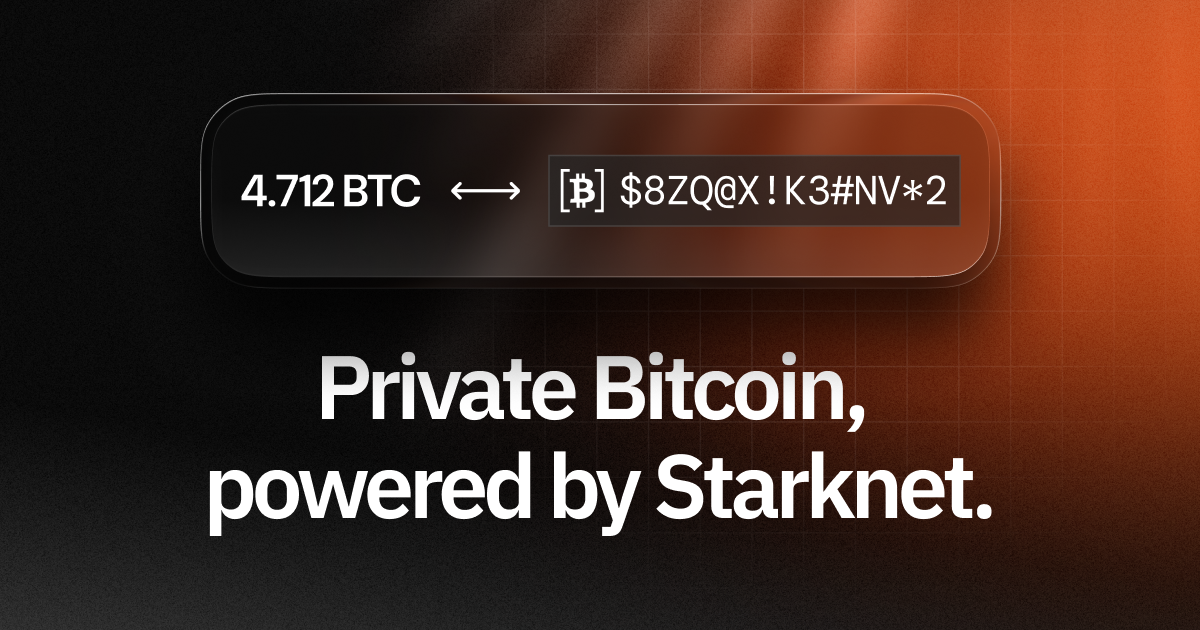
strkBTC is a Bitcoin-backed asset on Starknet that gives you something no other Bitcoin wrapper has delivered: programmable Bitcoin with native privacy. Xverse now supports strkBTC natively, including bridging, swapping, shielding, and earning yield.
Story details
Topics
Author(s)
Janlo van den HeeverPublished
May 12, 2026
Sign up for updates!
Stay tuned to our latest news and updates
.svg)
TL;DR
strkBTC is a Bitcoin-backed asset on Starknet that gives you something no other Bitcoin wrapper has delivered: programmable Bitcoin with native privacy. It is backed 1:1 by real BTC, fully composable across Starknet DeFi, and built on a trust-decay architecture that gets more trustless over time. Xverse now supports strkBTC natively, including bridging, swapping, shielding, and earning yield. Xverse is also a member of the strkBTC bridge federation.
The Privacy Problem Bitcoin Never Solved
In 2013, a mathematician named Eli Ben-Sasson walked onto a stage at a Bitcoin conference and presented an idea that most people in the room probably did not fully grasp at the time.
The idea was called a zero-knowledge proof. A cryptographic method that lets one party prove something to another party without revealing any underlying information. Ben-Sasson and his co-researchers had been working on a system called a zk-SNARK, short for Zero-Knowledge Succinct Non-Interactive Argument of Knowledge. It was dense, academic, and years ahead of any practical implementation.
But the core insight was simple and powerful: you should be able to verify the truth of a statement without exposing the data behind it.
Satoshi Nakamoto had actually hinted at this years earlier. In a 2010 BitcoinTalk forum post, Satoshi wrote about the potential for zero-knowledge proofs to enhance Bitcoin's privacy model. The tools just were not ready yet.
Ben-Sasson took that thread and ran with it.
From Theory to Zcash
In 2014, Ben-Sasson co-founded Zcash alongside Zooko Wilcox and others. Zcash was the first major blockchain to implement zk-SNARKs in production, giving users the option to send fully private transactions. For the first time, a public blockchain could verify transactions without exposing sender, receiver, or amount.
Zcash proved that cryptographic privacy was technically possible at scale. But it also revealed the limits of building privacy as a standalone chain. Adoption stayed niche. Most users defaulted to transparent transactions. The DeFi ecosystem that was rapidly expanding on Ethereum and later Bitcoin Layer 2s never materialized on Zcash.
The technology worked. The distribution model did not.
From Zcash to StarkWare to Starknet
Ben-Sasson took what he learned and founded StarkWare in 2018. This time, instead of building another chain, he focused on building the proving infrastructure itself. StarkWare developed STARKs (Scalable Transparent Arguments of Knowledge), a newer generation of zero-knowledge proofs that are faster, more scalable, and do not require a trusted setup.
This research became the foundation for Starknet, a validity rollup (often called a ZK-rollup) that settles to Ethereum. Starknet uses STARK proofs to compress thousands of transactions into a single proof that gets verified on L1. The result is a high-throughput execution environment with cryptographic guarantees baked into every transaction.
And with the introduction of the STRK20 token standard, Starknet gained something no other major execution environment had: native asset-level privacy. Not privacy as an add-on. Not privacy through mixing. Privacy enforced by zero-knowledge proofs at the token level, where balances and transfers are confidential by default when you choose to use them.
This is where strkBTC enters the picture.
What strkBTC Actually Is
strkBTC is a Bitcoin-backed asset on Starknet. Every strkBTC is backed 1:1 by real BTC held in the bridge reserve. It uses the STRK20 token standard, which means it supports both public and private modes natively.
In public mode, strkBTC works like any other wrapped Bitcoin. You can hold it, swap it, lend it, and use it across Starknet DeFi protocols.
In private mode, strkBTC balances and transfers become confidential. Zero-knowledge proofs verify that transactions are valid without revealing amounts, senders, or recipients. You get the programmability of a Bitcoin wrapper with the financial privacy that Bitcoin's base layer cannot provide on its own.
This is not a minor upgrade. It is a fundamental shift in what wrapped Bitcoin can do.
Why WBTC Is Not Enough
WBTC (Wrapped Bitcoin) was the first generation of Bitcoin wrappers. It served its purpose by bootstrapping BTC liquidity across DeFi. But it comes with structural problems that do not go away with scale:
WBTC relies on a centralized custodian to mint and redeem tokens. That custodian can freeze assets, introduce counterparty risk, and create a single point of failure. Balances and flows are fully traceable on the public ledger, offering zero privacy. And the trust assumptions are static. They do not improve over time. You are trusting the same custodian today as you will be five years from now.
For a self-custodial Bitcoin wallet focused on sovereignty, that model is fundamentally misaligned.
The Trust-Decay Architecture
What makes strkBTC different from every other Bitcoin wrapper is its roadmap. The trust model is designed to shrink over time, not stay fixed.
At launch, strkBTC uses a federation bridge. Multiple independent parties (including Xverse) collectively manage the BTC backing. This is already a significant improvement over single-custodian models like WBTC, but it is still a trust-based system.
The next phase introduces Bitcoin-anchored optimistic verification using BitVM-style proofs. This reduces the trust assumption to a single honest actor in the verification set. If even one verifier is honest, the bridge remains secure.
The long-term goal is full validity proof verification and covenant enforcement on Bitcoin L1 itself. At that point, the bridge becomes trustless. No federation. No honest-actor assumption. Pure cryptographic verification anchored to Bitcoin.
No other Bitcoin wrapper has this kind of progressive trust reduction built into its architecture.
How Xverse Supports strkBTC
Xverse now supports strkBTC across the full stack. Here is what you can do today.
Bridge BTC to strkBTC. Convert your native Bitcoin to strkBTC directly through Xverse Swap using the Atomiq bridge SDK. The flow works the same way as the existing BTC to WBTC bridge. Select BTC on Bitcoin as the source, strkBTC on Starknet as the destination, review the quote, and confirm. You can also bridge strkBTC back to BTC at any time.
Swap for strkBTC. If you already hold assets on Starknet (USDC, WBTC, STRK, or anything else), you can swap directly for strkBTC through the Xverse Swap interface.
Shield your strkBTC. This is where the privacy layer comes in. Activate the shield toggle in the top right corner of your Xverse wallet. Once activated, you can move strkBTC into private mode. Your shielded balance is only visible to you. Transfers between shielded wallets are fully confidential, verified by zero-knowledge proofs without exposing any transaction details.
You can unshield at any time by toggling back and selecting the amount to move back to public mode.
Send strkBTC privately. Once your strkBTC is shielded, you can send it to any other Starknet address with full confidentiality. The recipient receives the funds privately. No public trace of the amount or the counterparty.
Earn yield on strkBTC. Xverse Earn will support strkBTC staking through two paths. Liquid staking via Endur lets you mint xstrkBTC and stay liquid while earning yield. Native staking with the Xverse validator offers higher returns for those willing to lock up their position. Both options will be available directly in the Xverse Earn dashboard with full APY and TVL visibility.
Xverse Is a Bridge Federation Member
Xverse is not just integrating strkBTC as a supported asset. Xverse is an active member of the strkBTC bridge federation. This means Xverse operates one of the independent nodes that collectively secure the BTC backing for all strkBTC in circulation.
This is a direct commitment to the security and integrity of the strkBTC system. It also means Xverse has a vested interest in the success and progressive decentralization of the bridge as it moves through the trust-decay phases outlined above.
Why This Matters for Bitcoin Users
Bitcoin's base layer is designed for simplicity and security. That is its strength. But it also means Bitcoin cannot natively support the kind of complex financial logic that makes DeFi work. And its fully transparent ledger means every balance and transaction is visible to anyone who looks.
For years, the workaround was centralized exchanges. Park your BTC on an exchange, trade there, and accept the custody risk. Or wrap it into WBTC and accept the custodial wrapper risk. Neither option is acceptable for anyone serious about sovereignty.
strkBTC breaks that tradeoff. You get programmable Bitcoin on a high-performance execution layer. You get privacy when you need it. You get a trust model that improves over time. And with Xverse, you manage it all from a single self-custodial wallet.
This is what happens when a decade of zero-knowledge proof research meets the largest, most secure monetary network ever built.
FAQ
What is strkBTC?
strkBTC is a Bitcoin-backed asset on Starknet that uses the STRK20 token standard. Every strkBTC is backed 1:1 by real BTC. It supports both public and private transaction modes. In private mode, balances and transfers are verified by zero-knowledge proofs without revealing any transaction details.
How is strkBTC different from WBTC?
WBTC relies on a single centralized custodian with static trust assumptions and no privacy features. strkBTC uses a federated bridge with a trust-decay roadmap that progressively reduces trust requirements over time. It also supports native asset-level privacy through the STRK20 standard, something WBTC cannot offer.
How do I get strkBTC on Xverse?
You can bridge BTC directly to strkBTC through Xverse Swap, swap any Starknet asset for strkBTC, or acquire strkBTC through the strkBTC faucet during the early launch phase. Xverse handles the full flow natively across mobile and browser extension.
What does it mean to shield strkBTC?
Shielding moves your strkBTC into private mode. Once shielded, your balance is hidden from public view and any transfers you make are fully confidential. Zero-knowledge proofs verify that every shielded transaction is valid without exposing amounts, senders, or recipients. You can unshield at any time to return to public mode.
Can I earn yield on strkBTC?
Yes. Xverse Earn will support strkBTC yield through liquid staking (mint xstrkBTC via Endur) and native staking with the Xverse validator. Both options will show full APY and TVL details in the Earn dashboard before you commit any capital.
Is Xverse part of the strkBTC bridge?
Yes. Xverse is a member of the strkBTC bridge federation. Xverse operates an independent node that helps secure the BTC reserves backing all strkBTC in circulation.
What is the trust-decay architecture?
Trust-decay means the bridge's trust assumptions shrink over time. It launches with a multi-party federation, moves to optimistic verification (where security holds as long as one party is honest), and targets fully trustless verification anchored to Bitcoin L1. No other Bitcoin wrapper follows this model.
Download Xverse and get started with strkBTC today.


.svg)

Related articles
Borrow USDC Against Bitcoin Without Selling: Zest Collateral Vault + Xverse
Bitcoin holders face a paradox. The asset they refuse to sell is the same one they need liquidity from. The Zest collateral vault offers a self-custodial path: lock native BTC, borrow USDC on Ethereum, keep the long position.